Can the pivot to AI save crypto miners?
Over the past year, several crypto miners have decided to move away from the space and transition their data centers, power contracts, and infrastructure to focus on artificial intelligence (AI).
Over the past year, several crypto miners have decided to move away from the space and transition their data centers, power contracts, and infrastructure to focus on artificial intelligence (AI).
These miners include Applied Digital, Core Scientific, TeraWulf, Ionic Digital (formerly Celsius mining), and Keel Infrastructure (formerly Bitfarms).
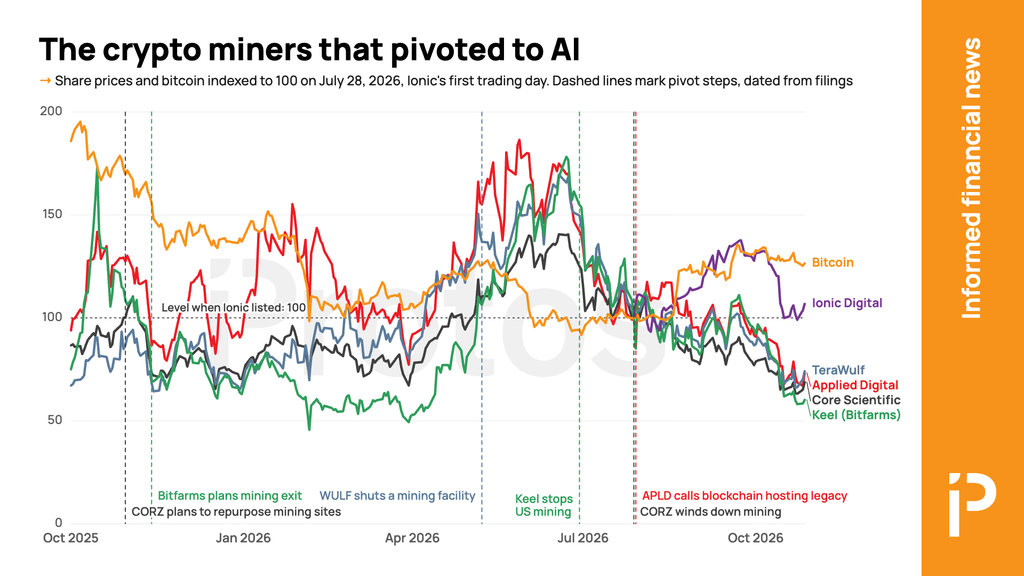
Indexed to the public listing of Ionic Digital, BTC has continued to outperform all of these former miners.
Indexed to the public listing of Ionic Digital, BTC has continued to outperform former miners that pivoted to AI.
Read more: China’s $340B AI bubble has popped — and the charts prove it
Applied Digital announced in its 10-K filed on July 29 that it’s “evolved from a company focused on blockchain hosting into a purpose-built HPC data center platform organized around our proprietary AI factory model.”
It added that its blockchain hosting operations are now a “single-customer component” of its business.
Core Scientific mentioned in its Form 10-Q filed on July 28 that its “hosted mining operations are expected to conclude by December 31, 2026, while we continue to wind down our self-mining operations.”
This wind-down had previously been mentioned as early as October 30, 2025, when it detailed its intention to “repurpose our remaining facilities currently used in our digital asset mining businesses to support our high-density colocation computing services business as circumstances allow.”
TeraWulf announced in its Form 10-K for fiscal year 2025 that it “has deliberately shifted capital allocation away from new BTC mining investments and toward HPC data center development.”
It does still maintain some mining facilities, though it seems to continue to be moving away from that industry.
Ionic Digital, which was spun out of Celsius Network during the bankruptcy, is a strange case because by the time it filed its S-1, it was already planning to “wind down our BTC mining operations over time.”
Bitfarms did an entire rebrand into Keel Infrastructure, announcing in late 2025 that it was hoping offering GPU as a service would help fund it “as we wind down our BTC mining business in 2026 and 2027.”
In February of this year, it announced its overall rebrand as Keel Infrastructure.
Firms that have pivoted have slightly outperformed miners that still get most of their revenue from mining.
Read more: River has sued Blockstream Services Canada over bitcoin mining services
It’s not exactly clear how much this pivot has helped the valuation for these firms.
If we index their prices to the beginning of this year, the firms that have pivoted have slightly outperformed miners that still get most of their revenue from mining; however, the firms still largely move together.
Even this isn’t a “real” comparison, because some of these firms have also started a pivot towards AI.
Iris Energy is leasing GPUs to Microsoft, Hut 8 is signing AI leases, Riot is entering into a long-term lease with a frontier lab, and Bitdeer is announcing multiple leases. They’re all actually heading more and more towards AI.
Mining itself is no longer a popular business for crypto miners, who are rapidly becoming AI infrastructure providers.
Got a tip? Send us an email securely via Protos Leaks . For more informed news and investigations, follow us on X , Bluesky , and Google News , or subscribe to our YouTube channel.
The post Can the pivot to AI save crypto miners? appeared first on Protos .