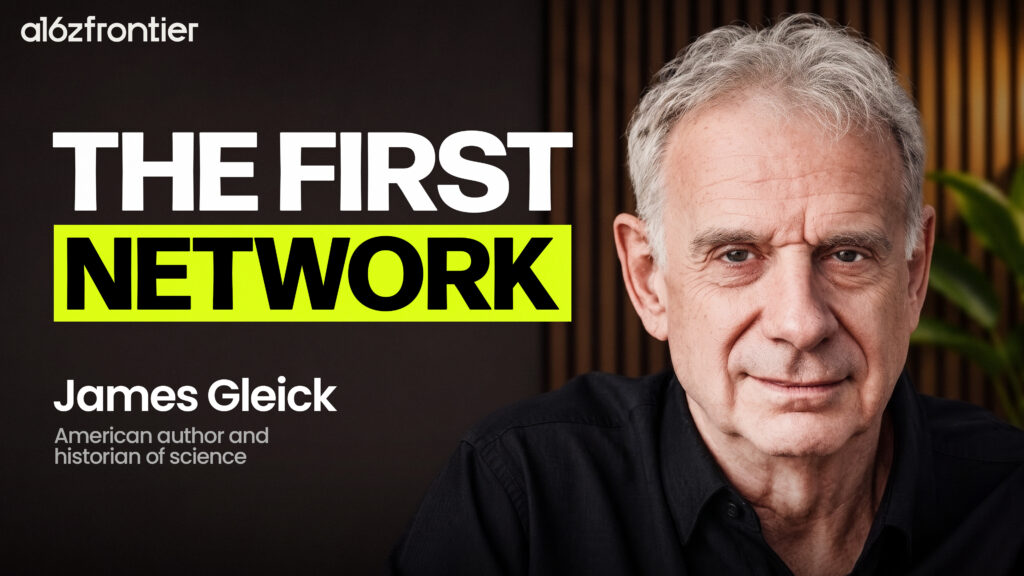
James Gleick on The Telephone: A New History
James Gleick — acclaimed science writer and bestselling author of Chaos: Making a New Science as well as biographies on polymaths Isaac Newton and Richard Feynman — joins Sonal Chokshi and Robert Hackett to discuss his
James Gleick — acclaimed science writer and bestselling author of Chaos: Making a New Science as well as biographies on polymaths Isaac Newton and Richard Feynman — joins Sonal Chokshi and Robert Hackett to discuss his new book, The Telephone: A New History . It is a story of a device — who really invented it, how? — of a network, of a lab, and of how innovation happens.
The telephone was dismissed as a toy or a frivolity — at best, something people could use to listen to concerts or sermons from home. Even with a working invention, everyone was still trying to figure out what a telephone was for, using the framework of what they already knew. Then its users started finding their own answers. Farmers built their own decentralized networks using barbed-wire fences — the “devil’s rope” — and, over time, research at a company built around phone calls helped lay the foundations of modern computing.
This conversation explores the nuances of building at the frontier: competing inventors, the experiments, the “scenius of genius.” Why did established businesses underestimate it? Did the telephone network have to become a monopoly? What made Bell Labs so productive?
And how a single invention could set off a technology revolution.
In this episode:
00:00 Intro: James Gleick and this new book
02:07 The messy invention of the telephone
03:53 When a “toy” becomes indispensable
08:15 How network effects changed the telephone
14:29 How farmers built a decentralized phone network from barbed wire
17:20 What Mark Twain missed while eavesdropping on his wife’s phone calls
20:12 To play monopoly or not?
31:22 Open vs. closed systems
37:17 What made Bell Labs (and Xerox PARC) more than one-hit wonders?
41:20 Scientists, tinkerers, and the conditions for invention
47:22 Debating whether AI is a fourth industrial revolution
52:11 How technology changes the way we think
54:18 James Gleick on solo writing vs. social conversation
58:25 The world brain
59:55 From “ahoy” to “hello, world”
Show notes
read The Telephone: A New History https://us.macmillan.com/books/9780374618940/thetelephone/
subscribe on YouTube https://www.youtube.com/channel/UCTHq3W46BiAYjKUYZq2qm-Q
subscribe to our Substack https://a16zfrontier.substack.com/
visit our website https://a16zfrontier.com/
follow us on X https://twitter.com/a16zfrontier
image credits (listed alphabetically by topic):
Alexander Graham Bell patent drawing [ Wikimedia Commons ]
barbed wire, Texas (Library of Congress)
Bell Labs campus, 2008 [ Wikimedia Commons ]
Bell System advertisement, 1912 [ Wikimedia Commons ]
Centennial Exhibition, 1876 [ Wikipedia ]
Edison & phonograph, 1877 [ Wikimedia Commons , Library of Congress]
Edison’s phonograph, 2004 [ Wikimedia Commons ]
ENIAC patent, 1954 [ historyofinformation.com , Jeremy Norman Collection of Images (Creative Commons)]
Hello World, 1978 [ Wikimedia Commons ]
Mathematical Theory of Communication , 1949 [ Wikipedia ] + Claude Shannon’s diagram of communication ( Bell System Technical Journal )
Reis telephone, 1863 [ Science Museum Group (Creative Commons)]
telegraph lines, 1871 [ Digital Commonwealth via Wikimedia Commons]
telegraphing Morse code, 1918 [ Wikimedia Commons ]
telephone operators, 1928 [ Library of Congress ]
transistor evolution 1941–1997, Bell System Memorial [ memorial.bellsystem.com ]
“We Learn about the Telephone”, 1965 [ YouTube via Maria Popova (Creative Commons)]
book covers, various
reference links & readings:
https://www.theatlantic.com/magazine/archive/1880/06/a-telephonic-conversation/306078/
https://www.historyofinformation.com/detail.php?id=639
https://en.wikipedia.org/wiki/File:Dial_up_modem_noises.ogg
https://www.quantamagazine.org/how-claude-shannons-information-theory-invented-the-future-20201222/
This content is for informational purposes only and should not be relied upon as legal, business, investment, or tax advice. Views expressed are those of the speakers and do not necessarily reflect those of a16z or its affiliates. For additional disclosures, visit https://a16z.com/disclosures/