Argentine Bitcoiners Debut “The Genesis of Satoshi Nakamoto” Artwork in Downtown Buenos Aires
TLDR — Bitcoin Magazine Argentine Bitcoiners Debut “The Genesis of Satoshi Nakamoto” Artwork in Downtown Buenos Aires “The Genesis of Satoshi Nakamoto,” a 2.
Bitcoin Magazine Argentine Bitcoiners Debut “The Genesis of Satoshi Nakamoto” Artwork in Downtown Buenos Aires
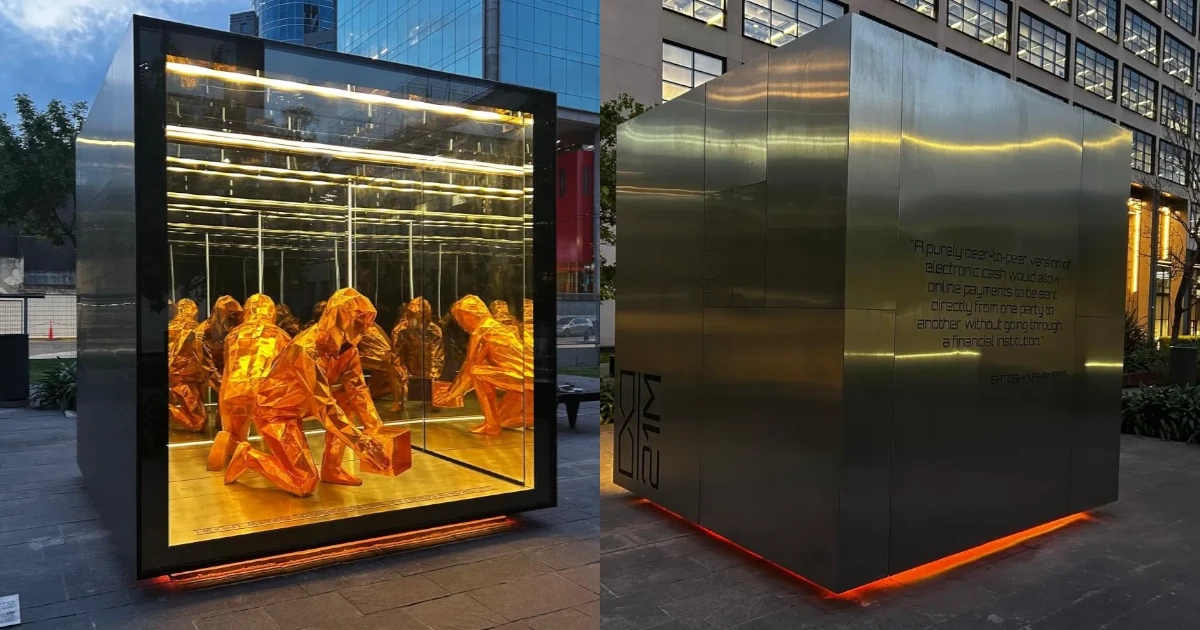
“The Genesis of Satoshi Nakamoto,” a 2.4-meter, multi-dimensional cube, was presented on October 29 at Polo Dot as part of the Open Fest of LABITCONF 2026 . Driven by Bitcoin.ar through the Premio B·Arte, the work combines art, technology, and education in a journey through Bitcoin’s fundamental principles. The inauguration featured guided remarks by Rodolfo Andragnes and a musical performance by Mayumaná, according to an announcement by the organization.
Buenos Aires now has a monument dedicated to Satoshi Nakamoto, the person—or group of people—behind the creation of Bitcoin, whose identity remains unknown.
Driven by Bitcoin.ar through the fifth edition of the Premio B·Arte, the monument was conceived not only as a tribute to Satoshi, but also as an artistic and educational experience. Through its five faces—four lateral and one upper—it proposes a journey to approach different concepts that explain Bitcoin’s origin, functioning, and philosophy.
During the inauguration, Rodolfo Andragnes — co-founder of Bitcoin.ar and LABITCONF — accompanied the public with words and explanations about the details of the work, guiding the reading of its various elements and the meaning behind each representation. The presentation was accompanied by a musical show by Mayumaná, which added rhythm and sound to the opening of this new space dedicated to Bitcoin’s history.
Five faces to discover Bitcoin’s history and principles
Each of the monument’s faces offers a gateway to a different aspect of Bitcoin. The figure of Satoshi Nakamoto, for example, represents the anonymous character of its creator and the collective dimension of a technology that, once set in motion, continued to grow thanks to thousands of people distributed around the world. The reflections and multiplied geometric forms also evoke the structure of a network that replicates and expands.
Another of its faces addresses Bitcoin’s programmed scarcity through a cube that successively divides into halves in a Fibonacci sequence. The representation refers to “the halving”, the mechanism that approximately every four years halves the reward miners receive for validating blocks and that regulates the issuance of new bitcoins. Starting at 50 bitcoins per block, the total reward gets cut in half every four years for roughly 130 years, until 21 million bitcoins have been emitted and the block reward becomes zero. This supply limit is iconic to the cryptocurrency and key to its qualities as hard money.
The work also incorporates the first words of Bitcoin’s foundational document, the white paper published by Satoshi Nakamoto in October 31st, 2008. There, the possibility of making electronic payments directly between people, without needing to go through a financial institution, is proposed. That idea constitutes a foundational principle of the technology.
Another face reproduces information from the genesis block, the first block of the Bitcoin chain, created on January 3, 2009. Among its elements appears the reference to the headline from The Times newspaper that Satoshi incorporated into that block, a historical mark that places Bitcoin’s birth in its context and anchors it to history and time.
Finally, on the upper part are two expressions that synthesize principles associated with this technology: “Don’t trust, verify”, an invitation to check information for oneself, rather than trust at face value. And “Vires in numeris,” Latin for “strength in numbers,” which refers to the safety of the crowd when it comes to privacy, as well as the self-evident, self-asserting strength of a money built and defended by cryptography rather than authority or military might.
Thus, the monument proposes something more than contemplating a sculpture: it invites one to walk around it, observe it from different angles, and discover the concepts behind each of its parts; “The intention is to bring Bitcoin closer to those who are already part of its community, but also to awaken the curiosity of those who do not yet know its history.”
A collective work that connects art, technology, and education
The monument was created by Ricardo Alonso, engineer, and Celeste Difabio Videla, architect, a couple of artists from Bariloche who won the fifth edition of the Premio B·Arte. The work measures 2.40 meters in width, length, and height, and is made of stainless steel and glass.
Its construction involved teams and collaborators from different localities across the country, in a process that combined different trades, materials, and techniques. Aída Pippo, visual artist, researcher of new technologies applied to art, and member of the Board of Directors of Bitcoin.ar, led the project and coordinated the different stages of production and assembly.
“It gives me great pride to feel that this is something we can leave in our city and in our country,” Andragnes expressed during the presentation, highlighting the value of a collective initiative that seeks to leave a cultural and educational footprint.
For their part, the creators noted that they sought for the work to function as a meeting point for the community and, at the same time, as a gateway for those who do not yet know Bitcoin. “You don’t always have the possibility of leaving something for posterity,” they shared when speaking of the experience of seeing the monument finished and installed in Buenos Aires.
With this inauguration, Bitcoin.ar seeks for the monument to become a permanent resource for the city: a space that schools, universities, families, and visitors can approach to learn Bitcoin’s history, discover its principles, and open new conversations about the future of money and technology. The intention is that what is presented today as an artistic work can continue to grow through educational activities and new experiences, and remain in Buenos Aires as a legacy for future generations.
The project was financed by the Fundación Bitcoin Iberoamérica and represents a new way of bringing Bitcoin’s history and principles to public and cultural spaces, beyond screens and specialized environments.
This post Argentine Bitcoiners Debut “The Genesis of Satoshi Nakamoto” Artwork in Downtown Buenos Aires first appeared on Bitcoin Magazine and is written by Juan Galt .
0 impressions · 0 upvotes · 0 comments
Discussion (0)
Reading is open to everyone — posting, replying and reporting need an account.
No comments yet.