If AI can do the math, what do mathematicians do?
TLDR — What’s it like to watch AI solve a problem you’ve spent years on?
What’s it like to watch AI solve a problem you’ve spent years on? Researcher Ittai Abraham spent about two years working on a set of math problems. Years later, he gave one of them to an AI model. In about an hour, it made progress where he’d gotten stuck.
Stanford cryptographer Dan Boneh takes that experience a step further. Suppose an AI settles P vs. NP, one of the biggest open questions in computer science. A computer can check every step, but the proof runs to a billion pages. What would we actually understand?
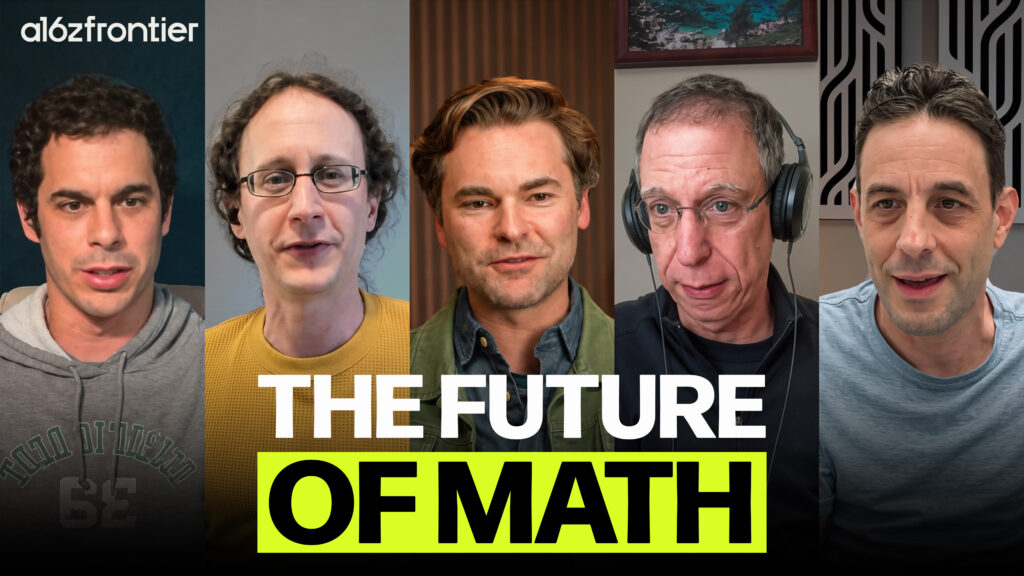
This episode brings together researchers — Abraham, Boneh, Scott Duke Kominers, and Justin Thaler — to talk about where math goes from here, now that AI is so good at solving hard problems.
Also: why a model can produce a correct proof and still skip key steps, how you develop a feel for which problems are worth pursuing, and what they’d tell a student deciding whether to spend the next five years on a math PhD.
This episode is for anyone wondering what happens to human knowledge if AI can prove things we may never understand.
Highlights: 00:00 Intro 05:39 Can mathematical discovery outpace human understanding? 10:38 When AI made progress a human couldn’t 13:56 What’s worth publishing when you can produce papers this fast? 18:40 How Lean checks a mathematical proof 22:10 The limits of AI: Too much work on an easy step, not enough on a hard one 27:54 Could math become more like astronomy? 31:45 What good is a proof if it runs to a billion pages? 41:00 What this moment feels like for a young mathematician 47:42 Two hard problems or 100 papers? How to judge a researcher 56:17 Does discovery feel different when AI helps? 58:09 Two problems a researcher has worked on since the 2000s. AI helped with one. 1:10:29 What should math professors teach now? 1:26:22 The case for more mathematicians
Mentioned in the episode: OpenAI math drop Fermat’s Last Tango William Thurston, “On proof and progress in mathematics” Lean, the open-source proof assistant Kirwin Hampshire, “The Dark Night of Mathematics” Terence Tao’s sketch of the proof about Landau–Siegel zeros discussed by Scott Steven Strogatz, “A Mathematician Reads the AI Future” Math paper with a fantastic “Disclosure of AI usage”
*** As always, none of the following should be taken as investment, business, legal, or tax advice. Please see a16z.com/disclosures for more important information, including a link to a list of our investments.
0 impressions · 0 upvotes · 0 comments
Discussion (0)
Reading is open to everyone — posting, replying and reporting need an account.
No comments yet.